By Tammie Horton, Patricia Falcetta OAM, and Dr Erica McIntyre
October was ADHD Awareness Month and Mental Health Month. Most organisations will have recognised both. The important question is: what is different on an ordinary Tuesday in November or any other day of the year?
What we see
Every October the same thing happens. A keynote. A lunch and learn. A message from the CEO and a wellbeing page on the intranet. The intent is real, and so is the effort. Then the month ends, the calendar fills, and work goes back to how it was: the same workloads, the same meeting habits, the same way performance concerns get raised, and the same unspoken rule about who is allowed to say they are struggling.
After a recent resilience training session Tammie ran, one participant said the materials were useful. Then they added: “I fear that, like most things, we’ll all go back to work and never make time to revisit this”. They had predicted the topic of this article — it’s one we’re very passionate about.
The three of us come at this from different directions. I (Erica McIntyre) work with neurodivergent women academics and professionals to navigate demanding work environments, researches their experiences in the workplace, and provides training on academic resilience and supporting neurodivergence in universities. Patricia Falcetta works with neurodivergent people and the organisations that employ them. Tammie Horton works on psychological safety and mental health and resilience in workplaces. We all bring our lived experience of neurodivergence or mental health in the workplace. From each perspective we keep seeing the same pattern: awareness arrives, but the system stays put.
October is not unusual. The Australian calendar has an awareness day, week or month for most of the labels a person might carry: neurodiversity in March, autism in April, suicide prevention and R U OK? Day in September, mental health, ADHD and invisible disabilities in October, disability on 3 December, and many more in between. There are good intentions behind each of these. But the calendar is organised by label, and people are not. Someone can be autistic, anxious, caring for a parent and managing a chronic illness in the same week, and no single awareness day describes them. The systems that shape their working life — how work is allocated, how performance is raised, or who is consulted — do not change with the label either. A calendar this full is a fair test of whether awareness alone changes how people are treated. October was also Safe Work Month, so the safety message is right in front of us. Psychological safety is a critical part of this that too often gets ignored.
To address this, we’re suggesting a simple check, which we call the Tuesday test. Take an ordinary Tuesday, not the day of the event, and pick any ordinary process: a request, a performance conversation, a team meeting, a change announcement. Then, ask:
Does the activity or situation work for those who are struggling and not saying so?
Do the conditions support their psychological safety and capacity to participate and do the work?
Is there certainty and clarity? Are expectations and processes clearly communicated?
The problem: awareness is not a control
The problem is not that the awareness event, training, or session was bad. These sessions are an administrative measure, and the hierarchy of controls puts those near the bottom. Safe Work Australia's model Code of Practice on managing psychosocial hazards says administrative controls are among the least reliable controls and give the lowest level of protection. It says to consider them last and to use them alongside more effective controls, starting with eliminating the risk at the source through the design of work. Each state and territory adopts the Code in its own way, so check the version that applies to you.
Awareness alone also raises the question: is the organisation just wellbeing washing? When a workplace only provides mental health, resilience or neurodiversity awareness training without strategies to support staff, it can be perceived as a tick box exercise. Staff need to feel supported, and know what actions their workplace is taking to resolve challenges (reducing psychosocial risk) and meet their needs.
Inclusion works the same way. Patricia's white paper describes the usual approach as reactive. Someone discloses, or a performance concern is raised, and only then does anyone realise the person is neurodivergent. Adjustments are made and the system around them stays exactly as it was. The burden of starting the change, justifying it and managing it sits with the individual, who is often already managing masking and sensory load. Her name for it is managed exclusion. Even in organisations committed to neuroinclusion, 33% of neurodivergent employees do not feel comfortable asking for an adjustment (Autistica, 2024), because asking can mean outing yourself or being seen as the difficult one.
The model Code makes the same point in regulatory language. Meeting one worker's disclosed need can be reasonably practicable, but the employer must still eliminate or minimise psychosocial risk for all workers. An individual adjustment does not discharge the duty.
For the person inside the system, this is hard to see from outside. Many of the women Erica coaches are late-identified ADHDers working in universities and the professions, and many are autistic or have other neurodivergent identities. From the outside they look like they are doing well, publishing and leading teams. Inside, they are just surviving. They are high achievers, and the strategies that get them through are the ones that also hide the cost. The price of masking is high and often invisible in the workplace, with high levels of stress and overwhelm. Over time burnout makes these impacts visible. Because ADHD in girls and women is often missed or identified late (Young et al., 2020), many have spent decades concluding that the problem is them, which amplifies their challenges.
On the mental health side we call this experience functional suffering: sustained strain carried by a person who keeps meeting the demands of their life at a cost, where the gap between how they are and how they appear is held in place by effort and concealment. Whether you call it masking or functional suffering, the person looks fine, and systems built around what is visible do not see them.
A good awareness session invites people to say what is true. That is only a good outcome if something is waiting for them — many people have reported nothing is. In Suicide Prevention Australia’s 2026 survey of 1,018 Australian workers, poor management support was one of the top contributors to work-related distress (39%), and only one in five said mental health was strongly encouraged and treated as a normal part of their workplace culture. Even when someone does speak up, the person they tell may not feel ready: 31% of entry-level staff did not feel confident responding to a colleague in serious mental distress.
Psychological safety is the shared belief that it is safe to take interpersonal risks at work, and telling your manager you are struggling is one of those risks. Where that belief is missing, choosing a formal or written route is a reasonable response. Writing creates a record, and it does not rely on how one person reacts in the moment. A written route gives people, especially neurodivergent people, certainty about what was said and the clarity to respond in their own time.
This raises another question for anyone who runs training sessions for managers: if managers attend and their teams still do not see them as capable, what has it achieved? A session changes what a manager knows, not whether people trust them. Trust comes from what happens next: whether the manager can act, whether the process behind them holds, and whether the person who spoke up sees something change. A manager sent back into an unchanged system cannot act to create the changes needed for psychological safety.
Another of Tammie’s participants asked what many do not say aloud: “when do you expect us to have all these conversations? We don't have time”. A session can ask people to listen, check in and talk, but if their workplace demands don’t decrease, awareness becomes an additional burden. Job demands are one of the psychosocial hazards in the model Code, and this is one example of how they show up in practice.
The cost
The visible cost is in compensation data. Safe Work Australia reports that mental health conditions made up 9% of serious workers' compensation claims in 2021-22 (preliminary), a 36.9% increase since 2017-18. Median time lost was more than four times that of physical injuries and illnesses, and median compensation more than three times. Psychosocial injury is expensive.
The cost affects some people more. The 2026 State of Workplace Burnout report found that women and people with a disability or chronic condition are more likely to experience a mental health issue or take time off due to mental health, and less likely to be engaged at work in unsupportive workplaces (Infinite Potential, 2026).
We can see this cost in neurodivergent employees. Only 25% of neurodivergent professionals feel truly included at work, and 39% have considered leaving because of poor workplace interactions (EY, 2025). In the Australian Public Service, about one in ten employees identify as neurodivergent, and in 2023 they reported discrimination at more than twice the rate of their colleagues: 20% compared with 9% (APS Employee Census). Neurodivergent employees are also often the first to feel the impacts of a psychosocially unsafe workplace and it costs them more.
Behind those figures are people deciding to go. In a resilience session Tammie ran recently, a participant disclosed that their place of work had been moved to the other side of town without consultation. They can no longer get to a parent who needs care during their lunch break, and they are thinking of leaving a job they have loved for 13 years. Their question was a fair one: why are we being asked to build our resilience when the organisation is doing this?
Resilience training of this kind should expect that question. Resilience skills help a person carry a load. They do not decide where or how the work happens or whether anyone is asked first. The model Code lists poor organisational change management as a hazard, and consultation as part of how it is controlled. Consultation provides an opportunity for influence.
In her article on capacity, Erica describes how resilience can’t be the responsibility of the individual alone. Resilience is the ongoing interaction between a person and the systems around them, and shifts with context and time. In a review of 176 studies of resilience in neurodivergent people, environmental factors made up the largest share of the factors associated with resilience, and the authors concluded that trait-based, individual ideas of resilience are not adequate for neurodivergent people (Black et al., 2024). In the workplace, this means that rather than asking “how can we make this person more resilient?”, Erica suggests asking “what conditions could change so that resilience has somewhere to grow from?” This question shifts the load from the individual to the organisation to design the conditions people need to be resilient.
Tammie delivers resilience sessions like this herself, and it is why she created SAFE2RISE: training is one part of the work, not the whole of it. If we are not also surveying and consulting workers, having the conversations, identifying the hazards, managing the risks and redesigning the systems that create them, we are missing the mark.
But claims and exit figures are the tip of the iceberg. Functional suffering is defined by not showing, so claims data undercounts it by design. In Suicide Prevention Australia's 2026 survey of 1,018 workers, 90% reported some work-related distress and 22% reported extreme distress, with heavy workload and burnout (61%) and poor management support (39%) among the top contributors. Only 20% said mental health is strongly encouraged and seen as a normal part of their workplace culture. The organisation's CEO, Nieves Murray, said: “Unfortunately, workplace distress in Australia is no longer the exception; it's the norm.” Her point was that this is not about individuals coping better, but about the systems, pressures and cultures built into workplaces.
The cost that appears in no budget is the one we should name plainly: suicide. When a person is failed by a system, the harm does not stay in the system, and it is rarely one system. Hazards interact and combine, and the model Code says combined exposure changes the level of risk. Three recent Australian matters show what that looks like.
Department of Defence. A RAAF technician was put on four Work Plans in six months as performance management while showing increasing signs of distress. His supervisors had not been trained to treat the process as a psychosocial hazard, and at no point referred him for support. He died by suicide on duty in 2020. In December 2025 Defence pleaded guilty and was fined $188,000. Comcare’s CEO said the risks were obvious and known through existing policies, and that policies "“can only ever mitigate risk if they are applied and followed in practice”.
NSW Department of Education. A school business manager who had worked at the same site for about 14 years was told in 2023 that she was under a misconduct investigation, to leave her workplace and not return, and to do alternative duties elsewhere. The letter gave no particulars of the allegations. After receiving it she attempted suicide. The investigation had been running about ten months when SafeWork NSW issued improvement notices in February 2024 on the Department's systems for the length of investigations and for the duties people are given during them. The Department itself accepted that psychosocial hazards are inherent in the investigation process. In March 2026 the NSW Industrial Relations Commission affirmed the notices, apart from one requirement about regular formal progress updates, which it removed.
Court Services Victoria. In 2023 they were fined $379,157 after admitting it had conducted no adequate process to identify risks. Staff had been exposed to traumatic material, role conflict and high workloads. An in-house solicitor, overloaded and with requests for support overlooked, died by suicide in 2018.
We are not saying a system alone causes suicide. It never is that simple, and the regulators’ findings concern failure to manage risk, not cause of death. We are saying these are the points where someone already carrying more than anyone can see meets a process that adds weight, and nobody is looking for it. In each case the failure sat in an ordinary process: performance management, an investigation, workload allocation.
Tammie facilitates Alternatives to Suicide peer support groups, and what she sees there is that the systems people live inside perpetuate the hazards and the risk of harm. Workplaces, family, housing, health, unemployment and disability support such as the NDIS are all examples, and it is rarely just one of them. Two Australian evaluations of these groups, from Curtin University and the University of Sydney, found participants linking their distress to interpersonal and wider injustices, including poverty, housing instability, discrimination and harm from services themselves. Both are small qualitative studies of people who chose to attend, and neither looked at workplaces, so we offer them as a consistent account from people with lived experience, not as proof of cause. The workplace is the system an employer can change, and it is rarely the only one a person is dealing with.
There is also a legal cost to running the event. What is reasonably practicable under WHS law depends in part on what an organisation knows, or ought reasonably to know, about a hazard and how to control it. Hosting an awareness session is evidence that the organisation knows.
The opportunity
The opportunity is that the work each of us does, in our different but common ways, is the work the regulator already expects. Patricia’s five principles show it clearly: all are psychosocial hazard controls, so changes in any of these areas support both neurodivergence and mental health at work.
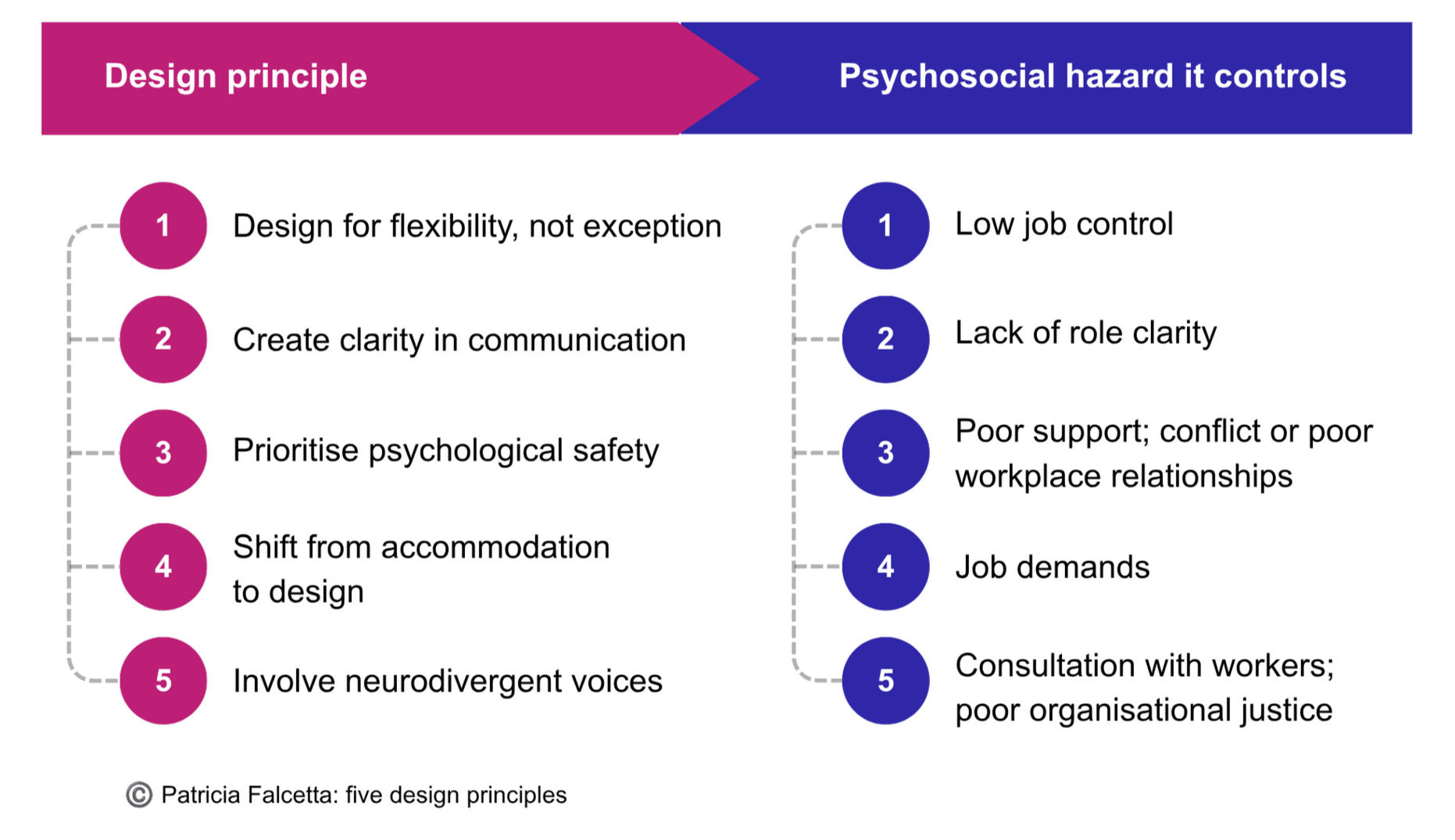
Diagram pairing Patrica’s five design principles with the psychosocial hazard each one controls. 1. Design for flexibility, not exception, controls low job control. 2. Create clarity in communication controls lack of role clarity. 3. Prioritise psychological safety controls poor support, and conflict or poor workplace relationships. 4. Shift from accommodation to design controls job demands. 5. Involve neurodivergent voices links to consultation with workers, and controls poor organisational justice.
The 2026 State of Workplace Burnout report highlights the importance of implementing these principles. They found that workplace design was critical for providing psychosocial safety, reducing risk of burnout and loneliness. Employees with more job security, resources to do the work, flexibility and agency have better mental health and are less likely to burn out.
Patricia's fifth principle is about neurodivergent voices. The same logic applies to anyone whose working life is shaped by a system they did not design: people with disabilities, people living with mental health conditions, people from different cultures, carers and others. The Code expects consultation with the workers likely to be affected, and a cross-section of voices will catch hazards that any one group would miss. Whichever door each of us comes through, whether neurodiversity, or psychological safety or mental health, we are asking organisations for the same things: consult, look at the work, change the design, and keep evaluating and refining.
Designing workplaces this way does not cost capability. Patricia's argument, and the evidence she cites, is that it adds to it: EY found that when neurodivergent employees feel included, their proficiency in future-focused skills such as AI, cybersecurity and creative thinking increases significantly. Remove sensory overload, ambiguous expectations, inflexible arrangements and meeting formats that suit only one kind of thinker, and the barriers come down for everyone.
Support is the lever. An analysis of 5,107 Job Satisfaction, Engagement, Connection, and Work Context (JSECC) workplace assessments (mostly from the education sector, and cross-sectional, so it shows association and not cause) found that psychosocial conditions explained far more of job satisfaction than personal resilience did, and that poor support had the strongest link to both satisfaction and engagement, even though it was not among the most common high-risk areas. Resilience still mattered, particularly for engagement. The two are complementary; they are not interchangeable. Tammie uses this tool in her work, so treat it as one dataset among others.
The window for change is in the weeks after the awareness event, when the language exists, people are primed and leaders have just been told what is at stake. Some organisations use their new knowledge well. When the Hawthorn Football Club's Inclusion Project team attended one of Patricia's workshops, two general managers were in the room, and they came looking at the work, not at the person. Staff set aside a full day to complete a Manual of Me, with an occupational therapist on hand to help them put their needs into words, and the manuals now guide how roles are tailored.
The solution: treat the session as the first step
The answer is to treat the session as the first step of a cycle, not the whole of it. This is the Awareness to Design Shift describe in the following steps:
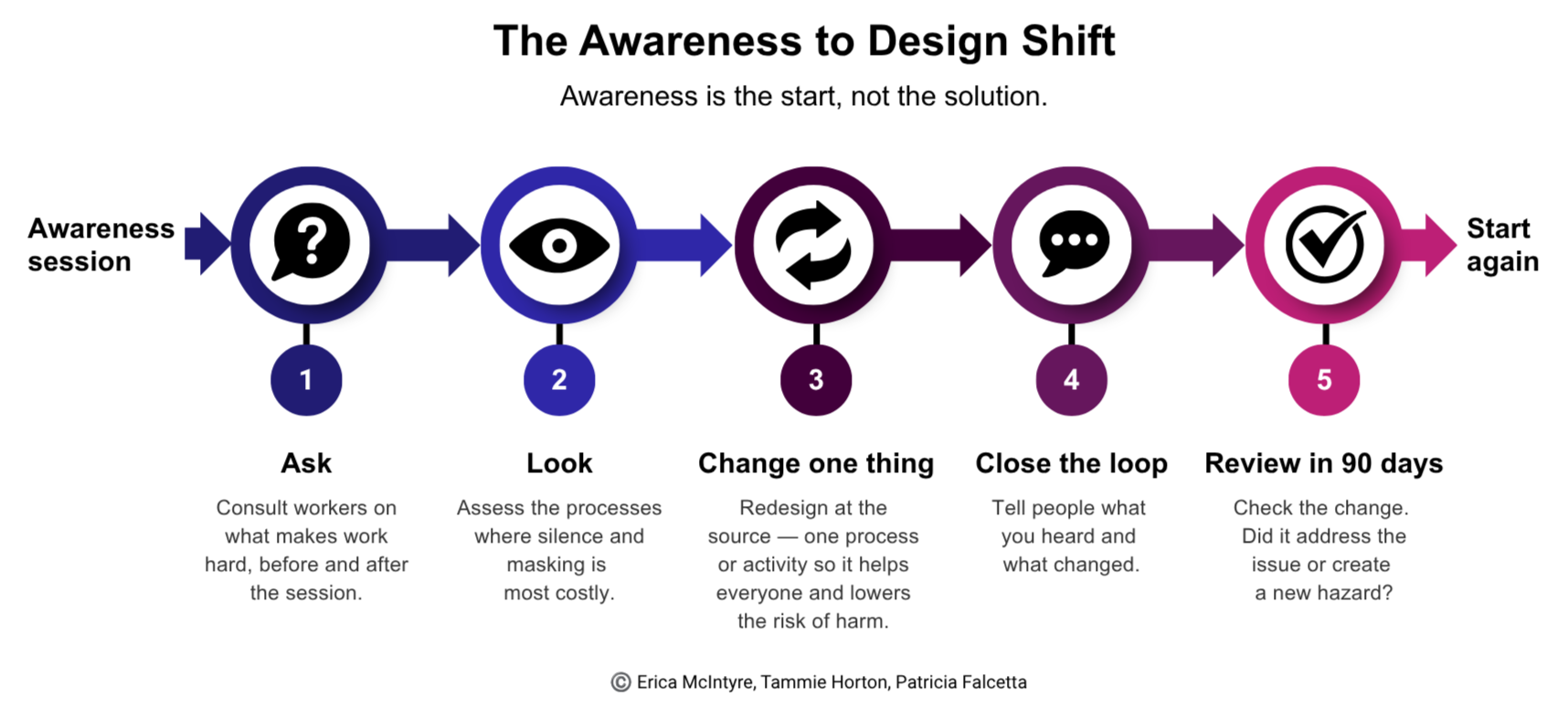
Ask. Consult workers on what makes work hard here, before and after the session. The Code requires consultation, and it must include a genuine chance to raise psychosocial risks.
Look. Assess the processes where masking is most costly: performance management, investigations, meetings, workload allocation, change announcements.
Change one thing at the source. Redesign a process so it helps all employees and reduces the risk of harm.
Close the loop. Tell people what you heard and what changed. This provides clarity and certainty. The Code lists advising workers of the outcome as part of consultation, and it is also the repair for the person who spoke up and saw nothing happen.
Review in 90 days. Check whether the change held and whether it created a hazard nobody anticipated, then go back to the first step and ask again.
It is a cycle because it is never finished. Any change can create a hazard no one expected: a new process can move workload onto someone else, and a flexible arrangement can quietly leave some people out of the conversation. The model Code says hazards interact and combine, and that control measures need to be reviewed and revised, so the last step feeds the first. Each time round, survey and consult again, have the conversations, identify what has changed, manage the risk and redesign where it is needed.
Step three is where one of Patricia's tools comes in. A Sensory Risk Assessment, completed for every new starter, shapes the workspace from day one, in the same way an ergonomic assessment does; the Digital Transformation Agency and Geoscience Australia have both adopted it. Role Chunking maps each part of a role against energy cost, deadlines, sensory requirements and support needs, so that when a performance concern appears, one of the first questions is whether the role needs redesigning, or a different role fits the person better. A task initiation tool, completed by the leader and the person together before the meeting ends, covers what done looks like, where the task sits and where to start. Energy Accounting shows that the biggest drains are often not personal at all: unplanned meetings, meeting overload and unpredicted change are design decisions.
Organisational coaching has an important place in this process too. It helps employees understand their strengths and challenges, how they’re affected by the context they work in, what they need to flourish at work, and how to advocate for their needs. Coaching also helps leaders understand how to work with and support neurodiverse teams. What it cannot do is redesign the workplace; a well-coached employee in an unchanged system is still in the same system that’s creating unnecessary burden.
Leaders carry the hardest part: hearing a mental health or neurodivergent disclosure or a workplace challenge as information, not as a threat. Challenger safety, the stage where people point out what they’re experiencing and what is broken in the workplace, is the hardest to achieve and the most valuable, because the people who experience and see a failing system first are often the ones who stop speaking when they are heard as disruptive, or feel dismissed or misunderstood. The person's safety depends on what the leader does next.
For the investigations and performance processes in the cases above, the cycle is concrete. Give people the details of the concern early. Set enforceable timeframes for actions, not guidelines. Make alternative duties or accommodations genuinely suitable. Train the people running the process to treat it as a hazard and to refer for support. And check that the written policy is what actually happens.
The Tuesday test, again
Next Tuesday, pick one process or activity and run the test. Ask three questions:
Who was the process designed for?
What happens to someone who is struggling and not saying so?
If they did speak up, who would hear it, and what could that person change?
If one process is not enough, here are six questions Tammie asks organisations to answer. They are mapped to ISO 45003, the closest thing there is to an agreed global benchmark for psychological health and safety at work. Answer how it actually is, not how it would look in a board report. If you do not know, say so, because that is useful information too.
Do people at every level feel safe raising a concern about workload, conduct or culture without fear of payback, or discrimination?
Are workers meaningfully consulted before changes are made to their roles or workload, not just told afterwards?
When poor behaviour is reported, is there real visibility into what happens next, regardless of who is involved?
Do people have real control over how they do their work, not just what they are told to deliver?
Do leaders and managers know exactly what to do, without hesitation, if someone at work discloses suicidal thoughts, self-harm, or that they are not safe?
Do you have current data on where psychosocial risk actually sits in the business?
To ensure safety for inclusion, Erica recommends asking four additional questions:
Do people feel safe to disclose a disability, chronic health condition, or neurodivergence without fear of discrimination?
Is there a clear, visible and accessible process to follow for an employee to disclose and ask for accommodations or support at work?
Do leaders and managers know what to do when someone discloses?
Do leaders and managers know how to work with and support neurodiverse teams, and neurodivergent employees?
October has passed. What matters now is whether anything about an ordinary Tuesday is different. The question is not what happened on the day, but what is still different in 90 days. We will take these questions into a panel discussion on Zoom on Wednesday 25 November, from 12 to 1pm AEDT. All three of us would like to hear what you find when reflecting on these questions.
Are you a university or people and culture leader?
Are you ready to take meaningful action for a safer more inclusive workplace?
If this article raises something for you, Lifeline (call 13 11 14), your GP, or employee assistance program can help.
Curious about how neurodiversity coaching can help your leaders support academics and professional staff?
Find out more about neurodiversity and resilience training for universities to create psychosocial safety.
References
Armstrong, P. (2023, June 20). What is ‘wellbeing washing’, and how can leaders avoid it? Australian HR Institute. https://www.ahri.com.au/articles/what-is-wellbeing-washing-and-how-can-leaders-avoid-it
Australian Public Service Commission. (2023). Neurodiversity in the Australian Public Service: Understanding our workforce (Research Note 09-23). https://www.apsc.gov.au/sites/default/files/2023-11/RN%2009-23%20-%20Neurodivergence%20in%20the%20APS.pdf
Autistica. (2024, December 4). Neurodiversity Employers Index (NDEI) market report 2024. https://www.autistica.org.uk/news/ndei-market-report-2024
Black, M. H., Helander, J., Segers, J., Ingard, C., Bervoets, J., Grimaldi de Puget, V., & Bölte, S. (2024). Resilience in the face of neurodivergence: A scoping review of resilience and factors promoting positive outcomes. Clinical Psychology Review, 113, Article 102487. https://doi.org/10.1016/j.cpr.2024.102487
Comcare. (n.d.). Defence convicted after RAAF worker death [Media release]. https://www.comcare.gov.au/about/news-events/news/defence-convicted-after-raaf-workers-death
Falcetta, P. (2026). Transformative inclusion by design [White paper].
Gardner, E., Gethin, A., Shukla, H., & Morgan, G. (2025, June 18). How can action on neuroinclusion accelerate business transformation? EY. https://www.ey.com/en_au/insights/consulting/how-can-action-on-neuroinclusion-accelerate-business-transformation
Infinite Potential. (2026). The state of workplace burnout 2026. https://infinite-potential.com.au/the-state-of-burnout-2026
International Organization for Standardization. (2021). Occupational health and safety management: Psychological health and safety at work: Guidelines for managing psychosocial risks (ISO Standard No. 45003:2021). https://www.iso.org/standard/64283.html
Jerzmanowska, N., Franks, S., Tseris, E., & Finlayson, C. (2022). Alternatives to Suicide research project: Exploring the experiences and impacts of a peer-based approach to responding to suicidal distress. University of Sydney.
McCullough Robertson. (2026, April 7). When investigations become hazards: Psychosocial risks in workplace investigations and what employers can do now. https://mccullough.com.au/2026/04/07/psychosocial-risks-in-workplace-investigations/
McIntyre, E. (2026, August). The tired that sleep doesn’t fix. Dr Erica McIntyre. https://www.ericamcintyre.com.au/blog/conditions-for-flourishing-capacity
Rhodanthe, L., Wishart, E., Watts, L., & Hodgson, D. (2022). Clarifying the Alternatives to Suicide approach: An evaluation of the theory, values, purpose and practice. Curtin University and ConnectGroups.
Rossouw, J. G., & McKenzie, S. (2026). Applied measurement properties and score interpretation of the JSECC psychosocial survey [Preprint]. ResearchGate. https://doi.org/10.13140/RG.2.2.30629.46565
Safe Work Australia. (2022). Model Code of Practice: Managing psychosocial hazards at work. https://www.safeworkaustralia.gov.au/doc/model-code-practice-managing-psychosocial-hazards-work
Safe Work Australia. (2024, February 27). Psychological health and safety in the workplace [Report]. https://www.safeworkaustralia.gov.au/media-centre/media-release/new-report-psychological-health-australian-workplaces
Secretary, NSW Department of Education v SafeWork NSW (No 2) [2026] NSWIRComm 1014.
Suicide Prevention Australia. (2026a). One in five Australian workers in extreme workplace distress [Media release]. https://www.suicidepreventionaust.org/one-in-five-australian-workers-in-extreme-workplace-distress
Suicide Prevention Australia. (2026b). Workplace and industry distress spotlight report. https://www.suicidepreventionaust.org/wp-content/uploads/2026/03/Spotlight-Report-Workplace-and-Industry-Distress-March-2026.pdf
WorkSafe Victoria. (2023, October 19). Court body fined almost $380,000 for deadly work culture. https://www.worksafe.vic.gov.au/news/2023-10/court-body-fined-almost-380000-deadly-work-culture
Young, S., Adamo, N., Ásgeirsdóttir, B. B., Branney, P., Beckett, M., Colley, W., Cubbin, S., Deeley, Q., Farrag, E., Gudjonsson, G., Hill, P., Hollingdale, J., Kilic, O., Lloyd, T., Mason, P., Paliokosta, E., Perecherla, S., Sedgwick, J., Skirrow, C., . . . Woodhouse, E. (2020). Females with ADHD: An expert consensus statement taking a lifespan approach providing guidance for the identification and treatment of attention-deficit/hyperactivity disorder in girls and women. BMC Psychiatry, 20, Article 404. https://doi.org/10.1186/s12888-020-02707-9