The tired that sleep doesn’t fix
Capacity, the first in a series on the five conditions for flourishing as an academic
Dr Erica McIntyre, PhD
There’s a particular kind of tiredness that sleep doesn’t fix. Ironically, I’m experiencing this right now. My capacity is low. As a fellow academic you might know this feeling.
Answering a single email feels like wading through thick mud. You’re managing about 40% of what you think you should be, and you’re feeling ashamed that everything seems to take you longer than it does for everyone else. From the outside you look like you’re doing well. You’re achieving a lot — getting published, leading teams, collaborating on impactful projects. Inside, you’re barely keeping up, and you’ve stopped believing the achievements belong to you — imposter syndrome has reared its ugly head.
I spent decades thinking I was flawed. I had an obsession with seeking productivity advice. Maybe a new productivity book would help — I have many of them. There was also a growing gap between what people saw I was capable of and what I could actually produce on any given day.
What I understand now, after researching mental health and wellbeing and the experiences of adults with ADHD, training as an ADHD-specialist coach, and 55 years of living in this brain, is that I wasn’t flawed — I was running out of capacity. This capacity had slowly depleted under conditions that weren’t built for me. Plus, I didn’t understand what conditions I needed to build or just maintain my capacity.
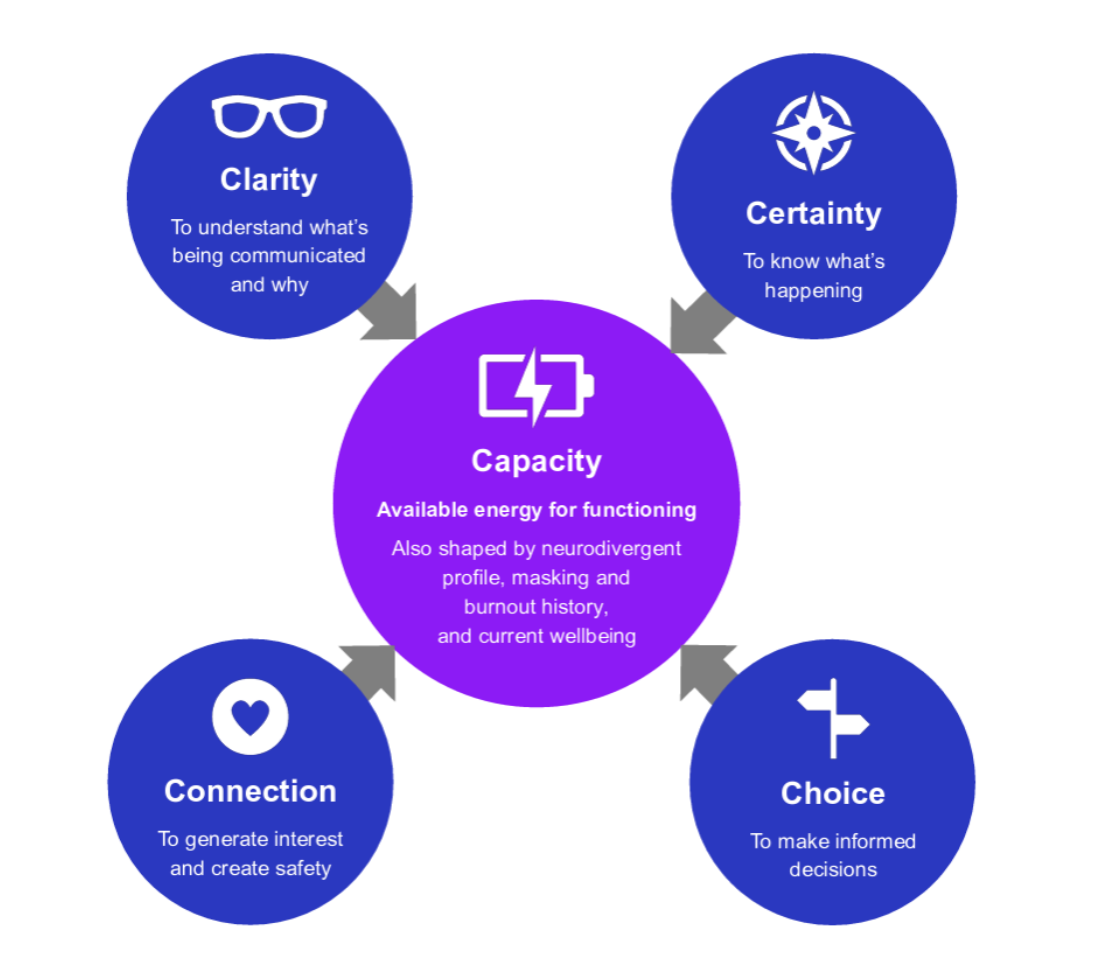
This is the first in a series on the five conditions I’ve come to understand neurodivergent (actually all) brains need to flourish. They are the 5 Cs: Certainty, Clarity, Choice, Connection, and Capacity. I’m starting with Capacity because it’s the one most of us feel first, and the one we’re quickest to blame ourselves for (“I should be able to do the thing”).
What capacity actually is
Capacity is the energy (physical and mental) you have available, right now, to do things — think, plan, regulate and act. If we have low capacity our executive functioning suffers, we can become emotionally dysregulated and things can feel harder to do, or even think about doing.
Four of the five conditions describe the quality of the world around you. Whether it’s predictable enough to feel safe (Certainty), understandable enough to act on (Clarity), whether you have real agency (Choice), and whether you have authentic and meaningful connection with others (Connection). Capacity builds and falls depending on how well those four conditions are being met, and on everything you’re carrying inside you: your masking and burnout history, your health, your intersecting identities, and how well your needs are being met.
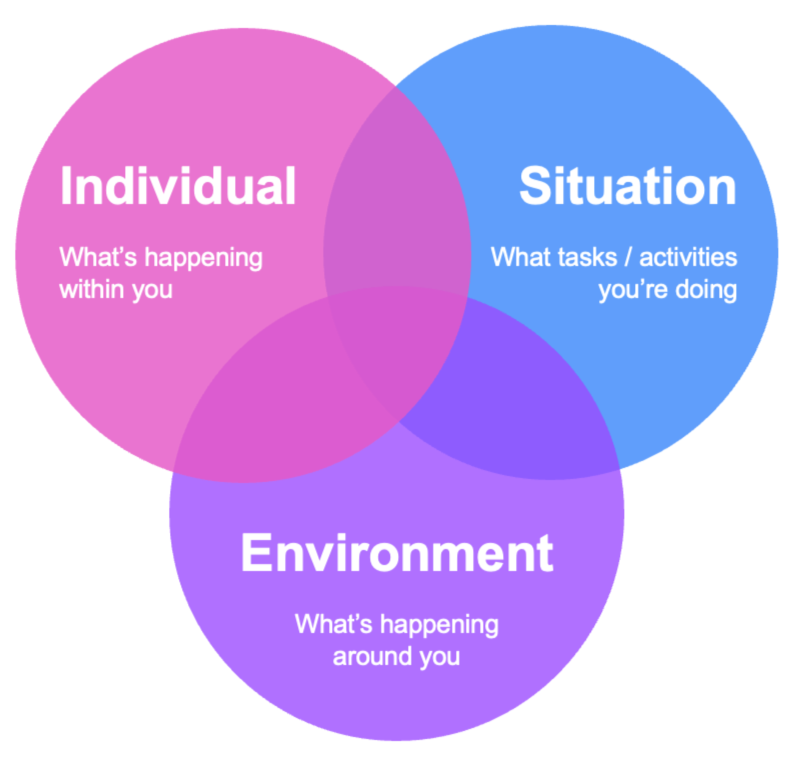
People don’t start with a fixed amount of capacity. Capacity emerges from context, from the interaction between three dimensions: the individual (what you’re carrying right now), the situation (the specific task, role or dynamic you’re in), and the environment (culture, systems, relationships, physical space). Change the context and the same person can feel and behave like a different person.
Capacity isn’t fixed — it’s dynamic. It moves, sometimes dramatically, often within a single day. This is situational variability, the way a person’s functioning shifts as those three dimensions interact.
When your energy fluctuates like that, other people can read it as inconsistency, unreliability, or a commitment problem. Carr (2026) explains what’s really happening with ADHD, describing attention as something continuously shaped by environmental rhythm, coherence and emotional climate rather than a stable internal trait that occasionally fails. What looks like inconsistency from the outside is a brain responding accurately to the conditions it’s experiencing. Most of us were never taught to think about it that way. In coaching, when people develop this understanding it often creates the biggest shift — and they start to experience a change in capacity as they are able to change the conditions around them.
What you carry as an academic
Start with the individual dimension, what you’re carrying right now. You can think of capacity as resources that are available for you at any moment in time — a bit like a rechargeable battery. Our capacity is shaped by a whole range of internal factors, and all of them fluctuate with context and time.
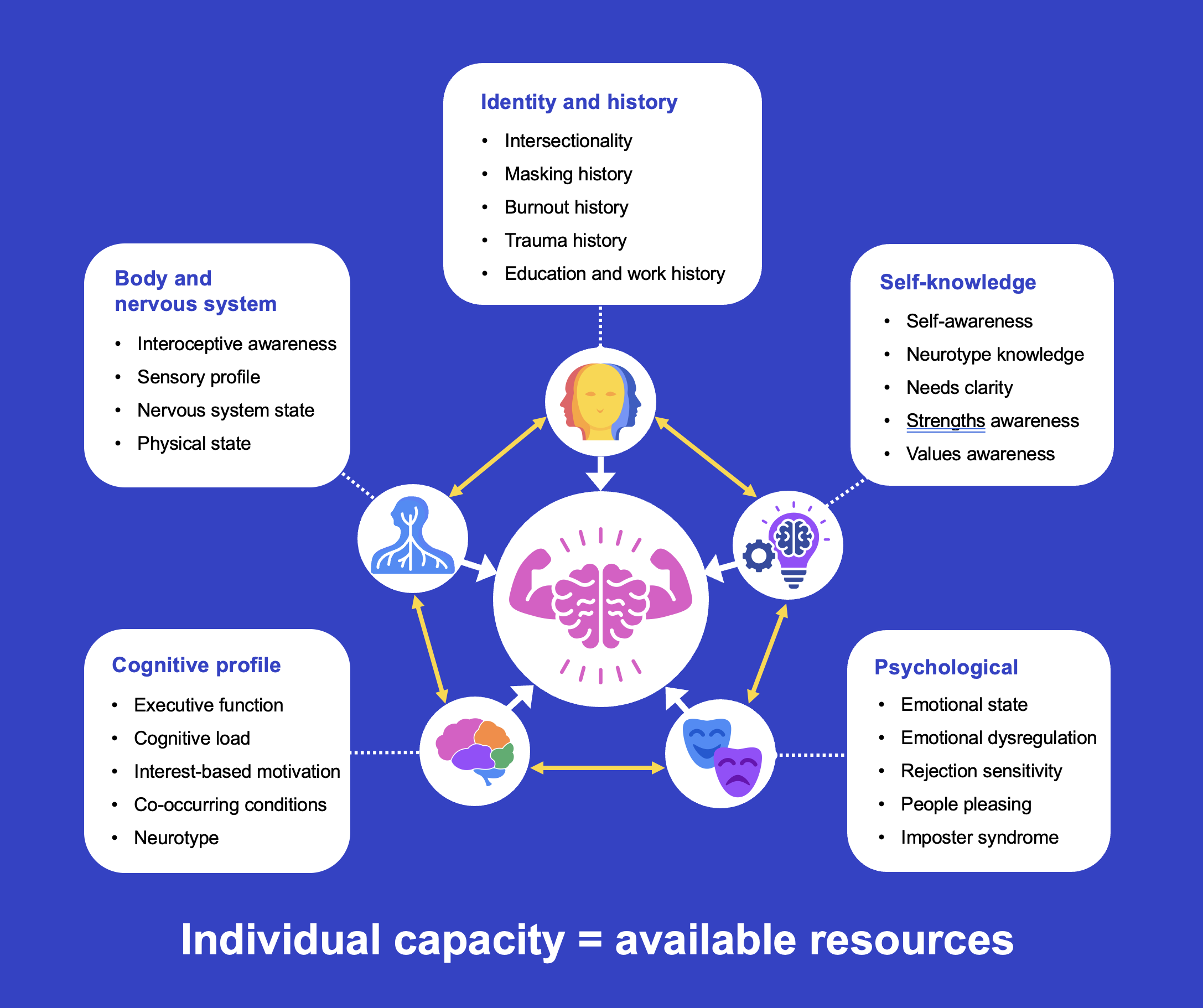
These individual factors cluster into five areas that also influence each other:
Your body and nervous system, including sleep, health, hormones, your sensory profile, and how easily you can read your own internal signals.
Your psychological state, including your current mood, your ability to regulate emotion, rejection sensitivity, and the continuous drain of masking.
Your identity and history, including how your intersecting identities (e.g. gender, race, caring responsibilities) affect you, cumulative masking, burnout and how well you recovered from it, trauma, and the grief that can come with a late identification.
Your self-knowledge, meaning how well you understand your own brain, how clearly you can name what you need, and whether your work aligns with your values.
Your cognitive profile, including executive function, interest-based motivation, current cognitive load, and any co-occurring conditions.
Two capacity drains deserve a special mention, because high achievers are especially good at hiding them.
The first is masking. In a systematic review covering 79 studies and more than 68,000 workers with ADHD across 22 countries, Hotte-Meunier et al. (2024) describe people spending so much mental effort dampening their own hyperactivity and impulsivity that they were left exhausted, with nothing left to start their work. Participants described changing themselves to fit the job rather than the job being changed to fit them, and trying to do the work the way someone else did the work. Trying to fit the job and work like others do have been two of the biggest energy drains in my academic career, and I hear this experience from my coaching clients too.
The second drain is overplayed strengths. Crook and McDowall (2024) conducted research with ADHD adults and found that the traits driving people’s greatest career successes were the same ones that drained them. Energy, enthusiasm and hyperfocus produce brilliant work, but when not managed, running on hyperactivity and keeping up appearances can lead to reduced capacity and burnout. Their participants also described achievements that never quite felt like their own (think “imposter syndrome”) — they described a sense of being an underachiever who hadn’t lived up to their potential despite an objectively impressive track record. Success and depletion were both fuelling and sabotaging their work.
Your battery only works if you remember it recharges. Capacity does come back, though rarely when we follow one size fits all advice. What restores it tends to be specific to the person and their interaction with the situation and environment. When my capacity drains after sitting at the computer all day movement is usually what restores it — this is always more effective if listening to music (think of me dancing in my lounge room). If I’ve been drained by a work meeting, I need a different quiet type of rest, like walking alone in the bush focusing on bird song.
Too often we focus only on changing the individual part of the context. While this is important, it isn’t always possible — I will always have ADHD and a trauma history. Sometimes the biggest gains are changing the situation or environment. If you’re neurodivergent you’ve probably heard… “You just need to [insert productivity advice here]”. If your university won’t support you to have breaks between meetings, how can you effectively manage your capacity?
What you’re in
The situation is the immediate dimension, the particular task, role or dynamic you’re in right now. The same person, in the same job, on the same day, will have very different capacity in a 2-hour meeting with no agenda than a bounded piece of work with a clear deadline and a genuine interest in it.
Structure, novelty, time of day, how much of the task is undefined, who else is in the room, all of these influence capacity in ways that have nothing to do with how much you care or how hard you’re trying. It’s also why deadlines help ADHDers rather than hinder us, because they collapse an open-ended situation into a defined one — providing clarity.
We can also prevent the battery from draining too quickly if we manage the situation and environment. A few years ago, when still in my academic job, I would get to the end of a day completely wasted — 5% left in my battery, just enough to listen to music on the over 2-hour hour train trip home. A hideous combination of working in an open-plan office with artificial lighting and air conditioning plus back-to-back meetings was causing this drain. This would be bad for most academic women, but for my neurodivergent brain and nervous system the impact was significantly amplified.
Once I recognised what I needed, I was able to minimise it. I stopped back-to-back meetings, allowed for transition time between situations — so I could comfortably get a drink and go to the toilet — and ensured I walked outside at lunch.
Being neurodivergent, the environment we’re in has a significant impact on capacity. Hotte-Meunier et al.’s (2024) systematic review of strengths and challenges related to ADHD in employment supports this. They found person-environment fit shaped job satisfaction, performance, and how long people stayed in their job. Some of their participants had come to locate their challenges in the environment rather than inside themselves, and doing that dissolved many of the feelings of inadequacy they’d had.
I’ve felt the difference in my body at the final residential of my coach training — all four environmental conditions were in place at once. I felt safe and knew what was coming (Certainty), I understood what was being asked of me (Clarity), I had genuine choice about how I engaged (Choice), and I was among people who understood how my brain worked (Connection). My capacity didn’t drain under the demands of intensive learning. It increased, giving me the energy to authentically learn, feel, connect and create.
Why resilience can’t be installed in a workshop
Capacity connects to something we talk about and often get wrong — resilience.
Resilience is often considered a personal quality — some people bounce back, some don’t, and the ones who don’t “should” build more of it. It’s the individual’s responsibility to learn how to cope and have good wellbeing despite working in shitty conditions. We see this in many organisations that offer “wellbeing” programs, while doing little to address the workplace environment — asking staff to focus on the positive and absorb whatever their environment creates, while nothing about that environment is asked to change. This is wellbeing washing.
Individuals can build resilience to adversity. But, should this be the first expectation of organisations? More recent conceptualisations of resilience use a social-ecological frame that emphasises the role of the environment. For example, Shafi and colleagues (2020) describe resilience as an emergent property of the ongoing, reciprocal interactions between a person and the systems around them, one that shifts with context, relationship and time. Seen this way, resilience isn’t just a personal skill or trait. It emerges, or it doesn’t, from conditions.
In organisations the useful question isn’t “how do we make this person more resilient?”, it’s “what conditions could change so that resilience has somewhere to grow from?”.
The evidence supports this. Black et al. (2024) reviewed 176 studies of resilience in neurodivergent people and mapped every biopsychosocial resilience factor they found onto the World Health Organization’s International Classification of Functioning. Environmental factors accounted for the largest share of resilience factors (35%), followed by activity and participation (30%), body functions (20%), and personal factors (15%) the smallest group. They concluded that trait-based, individually-focused ideas of resilience aren’t adequate for neurodivergent people. They also argued that neurodivergence can be constructed as an adversity, given the increased likelihood of negative experiences from poor person-environment fit. Importantly, they note that when environments are a good fit, that adversity may not be experienced at all.
This makes resilience and capacity close relatives. Both get treated as things you either have or lack. Both are produced, in large part, by situational and environmental conditions. When we tell a depleted person to build more resilience, we’re asking them to generate from within something that mostly comes from around them. For organisations, it means resilience can’t be installed in a lunchtime workshop. It grows out of culture, workload, support and connection.
Universities are the extreme case, not the exception
I use universities as my example because I worked in them for over a decade and they concentrate everything: insecure contracts, metric-driven performance, unbounded workloads, and a culture that treats overwork as devotion and rest as something to feel guilty about. The sector’s own data confirms this. In the Australian University Census on staff wellbeing, 82% of respondent academics reported high or very high emotional exhaustion, against a national workplace benchmark of around 50% (Dollard et al., 2026). Dreisoerner et al. (2026) found elevated psychological distress in nearly one in three early-career researchers internationally, with demographic and individual characteristics having limited associations.
We found something similar in our study of Australian academics with ADHD, led by my honours student Laura Opie (2024):
Workplace demands in universities significantly predicted burnout in academics.
Feeling supported and understood at work was associated with better wellbeing and less burnout in academics.
What wasn’t associated with either outcome was the individual factors: age of identification, how many co-occurring conditions someone had, how many management strategies they were using. This highlights that the quality of the situation and environment matters the most.
If you lead somewhere else that runs on smart people and demanding work, in law, health care, consulting, tech or the public service, the experience will be familiar, and so are the levers. Workload models that reflect real hours. Contract design that doesn’t make security a lottery. Promotion criteria that reward more than output volume. Adjustments co-designed with the person rather than pulled from a template — given that in our research most participants weren’t receiving adjustments at all, and the support they most wanted was inclusive culture and genuine ADHD awareness.
Most people in universities are disengaging and burning out because they’re running out of capacity, in conditions their organisation’s leaders have much more control over than they do.
What changes in coaching
Many of the people I coach arrive believing the problem is them. What shifts first is rarely a strategy — it’s self-knowledge.
They start noticing what actually depletes and what restores them. They begin naming needs to themselves, often for the first time, and discover those needs had been going unmet for years, which explains a lot about how they’d been feeling. Then they start expressing those needs to other people, and find they can be met after all. Overwhelm stops being evidence of failure and becomes information they can work with. Frustration and cynicism, which are entirely reasonable responses to bad conditions, stop being the only available options.
Coaching can’t fix an insecure contract or repair a broken institution. Systemic problems need systemic change, and pushing for that matters to me as much as the one-to-one work. What coaching does is help you understand your own brain well enough to protect your capacity before it runs out, advocate for better conditions where you have influence, and stop paying the shame tax on a low day.
That’s the shift from surviving to flourishing — more often, more sustainably, and on your own terms.
A better question to ask yourself
If your capacity feels low right now, try a gentler question than the one you probably ask yourself.
Not “why can’t I keep up?”, but “which conditions around me are missing, and what would it take to create them?”
That move, from self-blame to understanding the conditions needed, is where the change usually starts.
Curious about how coaching can help you manage your capacity as an academic or professional woman?
This is Part 1 of a five-part series on the conditions for flourishing. Next: Certainty.
A note on language: I prefer identity-first language, reflecting my own lived experience as an ADHDer, and “late-identified” rather than “late-diagnosed” to include people who recognise their ADHD without a formal diagnosis. I respect that people may identify differently.
Dr Erica McIntyre (PhD) is a certified ADHD-specialist coach, career and leadership coach, researcher and educator. She has been researching the experiences of adults and university students with ADHD and neurodivergence since 2023 and mental health and wellbeing for over a decade. As a late-identified ADHDer she brings both research and lived experience to her work with high-achieving late-identified neurodivergent women and the organisations that employ them.
Find out more at ericamcintyre.com.au/abouterica or follow along on Substack.
References
Black, M. H., Helander, J., Segers, J., Ingard, C., Bervoets, J., Grimaldi de Puget, V., & Bölte, S. (2024). Resilience in the face of neurodivergence: A scoping review of resilience and factors promoting positive outcomes. Clinical Psychology Review, 113, 102487. https://doi.org/10.1016/j.cpr.2024.102487
Carr, B. R. (2026). Fielded attention: Reframing ADHD through a relational ontology of context. Journal of Attention Disorders. https://doi.org/10.1177/10870547261416163
Crook, T., & McDowall, A. (2024). Paradoxical career strengths and successes of ADHD adults: An evolving narrative. Journal of Work-Applied Management, 16(1), 112–126. https://doi.org/10.1108/JWAM-05-2023-0048
Dollard, M. F., Neser, D., Lushington, K., & Zadow, A. (2026). Australian university sector report: Findings from the Australian University Census on staff wellbeing [Technical report]. Adelaide University. https://stresscafe.net/census
Dreisoerner, A., Goetz, V., Frohnmayer, D., Tran, U. S., Voracek, M., & Nater, U. M. (2026). Prevalence and severity of mental health problems in early-career researchers: A systematic review and meta-analysis. Nature Human Behaviour. https://doi.org/10.1038/s41562-026-02505-5
Hotte-Meunier, A., Sarraf, L., Bougeard, A., Bernier, F., Voyer, C., Deng, J., El Asmar, S., Stamate, A. N., Corbière, M., Villotti, P., & Sauvé, G. (2024). Strengths and challenges to embrace attention-deficit/hyperactivity disorder in employment: A systematic review. Neurodiversity, 2, 1–13. https://doi.org/10.1177/27546330241287655
Shafi, A. A., Templeton, S., Middleton, T., Millican, R., Vare, P., Pritchard, R., & Hatley, J. (2020). Towards a dynamic interactive model of resilience (DIMoR) for education and learning contexts. Emotional and Behavioural Difficulties, 25(2), 183–198. https://doi.org/10.1080/13632752.2020.1771923